Disadvantages of Geogrids: When They Don’t Work (And Why)
🔎 Short Answer
Geogrids may underperform when the underlying problem is not structural. They do not fix drainage failures, surface gravel migration, poor base preparation, or incorrect material selection.Geogrid performance depends on proper product selection, aggregate interlock, compaction, drainage design and installation quality. When geogrid is misapplied, it can add cost without solving the root cause of the project failure.
What Most People Get Wrong About Geogrids
Geogrids are structural reinforcement materials. Their main function is to improve load distribution, increase soil stability and reduce deformation in weak subgrades.
However, geogrids are not designed to replace:
Drainage systems
Surface gravel stabilizers
Erosion control blankets
Cosmetic gravel containment solutions
Misunderstanding the failure mechanism is one of the most common reasons geogrid appears ineffective.
If you are evaluating geogrids for traffic-bearing surfaces, you may also want to read our guide on how long driveway grids last and what affects their real-world lifespan.
1️⃣ Geogrid Does Not Replace Drainage

When failure is water-driven
If rutting or softening is caused by:
-
Water pumping
-
Trapped moisture
-
Poor subgrade drainage
-
Fine migration
Then reinforcement alone will not solve the issue.
Why?
Water reduces soil shear strength.
Reinforcement cannot compensate for continuous saturation.
What to consider instead:
-
Base redesign
👉 Internal link: Geogrid for Road Construction
2️⃣ Surface Gravel Movement Is Not Always a Structural Problem

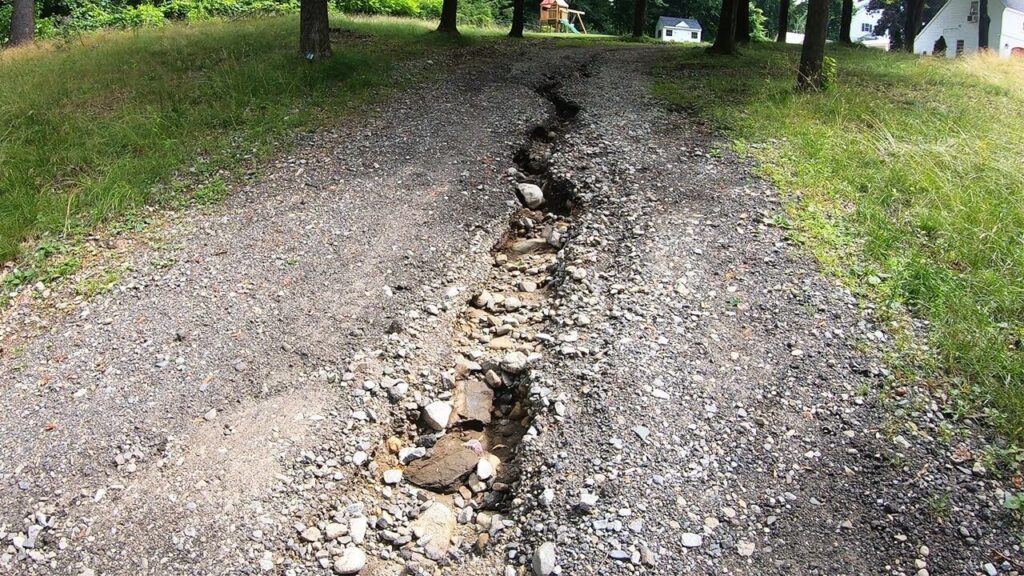
Many driveway issues are surface-related:
-
Gravel spreading
-
Tire scuffing
-
Washboarding
-
Minor displacement
In such cases, a confinement system may perform better than a reinforcement grid.
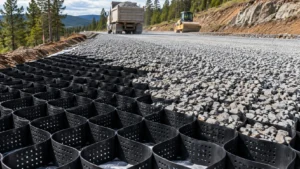
For traffic-bearing gravel surfaces, the first step is to determine whether the problem is structural rutting or surface gravel movement. If the base is stable but the surface gravel keeps spreading or migrating, a confinement system may be more suitable than a reinforcement geogrid.
👉 Internal links:
3️⃣ Wrong Geogrid Type for the Application
Different applications require different reinforcement characteristics.
Common mistakes include:
-
Using a base stabilization grid for a retaining wall
-
Selecting based on ultimate strength instead of stiffness
-
Ignoring design strain levels
Performance depends on matching product properties to loading conditions.
Many geogrid problems come from wrong product selection or poor installation. A geogrid used for road base stabilization may not be suitable for retaining wall reinforcement, and a grid selected only by ultimate strength may not perform well under actual design strain conditions. You can review our HDPE geogrid product specifications before choosing a material.
👉 Internal link: Biaxial vs Uniaxial Geogrid
4️⃣ Poor Aggregate Interlock

Geogrid reinforcement depends on mechanical interlock between the aggregate and the geogrid apertures. If the aggregate is too fine, poorly graded or not compacted properly, the load transfer mechanism may not fully develop.
If aggregate:
-
Is too fine
-
Does not properly fill apertures
-
Is poorly compacted
The expected load transfer benefit will not fully develop.
Proper base thickness and compaction are critical.
5️⃣ Installation Errors Reduce Performance

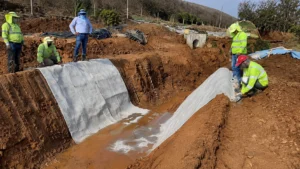
In many projects, poor performance is not caused by the geogrid material itself, but by installation errors. Wrinkles, insufficient overlap, early traffic loading and inadequate cover material can all reduce reinforcement performance.
Common construction issues:
-
Wrinkled placement
-
Insufficient overlap
-
Early trafficking without adequate cover
-
Inadequate compaction above the grid
Even high-quality materials can underperform when installation standards are not followed.
6️⃣ When Geogrid May Not Be Necessary
For light-duty or cosmetic surface problems, geogrid may not be the most cost-effective solution. In these cases, improving surface containment, drainage or base preparation may provide better results than adding reinforcement.
Geogrid may offer limited value when:
-
Subgrade strength is already high
-
Traffic loading is light and infrequent
-
The issue is purely cosmetic
-
Adequate base thickness already provides stability
Engineering judgment should determine necessity, not assumptions.
7️⃣ When Geogrid Does Work Well
To avoid overcorrection, it’s important to understand appropriate use cases.
For a gravel driveway application, it is also worth reviewing driveway geogrid lifespan before choosing a grid type.
Geogrids are most effective when:
-
Subgrade is weak or highly compressible
-
Repeated traffic loading causes rutting
-
Structural load distribution is required
-
Reinforced soil structures are being built
| Project Condition | Why Geogrid Helps |
|---|---|
| Weak or compressible subgrade | Improves load distribution and reduces deformation |
| Repeated vehicle loading | Helps reduce rutting and base movement |
| Retaining wall reinforcement | Provides tensile reinforcement in the soil mass |
| Road base stabilization | Improves aggregate interlock and base performance |
| Asphalt pavement reinforcement | Helps reduce reflective cracking when fiberglass geogrid is used |
| Slope stabilization | Supports soil reinforcement when combined with proper drainage |
👉 Internal links:
Recommended Geogrid by Project Type
Different projects require different geogrid structures and strengths. Choosing the right geogrid type can help reduce installation problems and improve reinforcement performance.
| Project Type | Common Problem | Recommended Product |
|---|---|---|
| Retaining wall | Soil pressure, wall movement, poor backfill stability | Uniaxial geogrid / HDPE geogrid |
| Road base | Rutting, weak subgrade, aggregate movement | Biaxial geogrid |
| Asphalt pavement | Reflective cracking and surface fatigue | Fiberglass geogrid |
| Slope stabilization | Surface erosion and soil movement | HDPE geogrid / geocell |
| Gravel driveway or access road | Gravel migration and surface deformation | Geocell / gravel grid |
| Soft ground improvement | Weak soil bearing capacity | Biaxial geogrid / geotextile combination |
The best geogrid choice depends on wall height, soil condition, load requirement, project area and installation method.
How to Avoid Common Geogrid Problems
Choose the right geogrid type
Uniaxial geogrid, biaxial geogrid and fiberglass geogrid are designed for different applications. Using the wrong type may reduce the reinforcement effect and lead to poor project performance.
Prepare the base properly
Geogrid should be installed on a properly prepared and compacted base. Sharp stones, loose soil and uneven surfaces can affect installation quality.
Use proper overlap and anchoring
Insufficient overlap, weak anchoring or incorrect placement may reduce the reinforcement effect. Installation details should follow project requirements and product recommendations.
Do not ignore drainage
For retaining walls and slope projects, drainage is as important as reinforcement. Poor drainage can increase soil pressure and reduce long-term stability.
Match geogrid strength with project load
Projects with vehicle loads, retaining walls, slopes or weak subgrades may require higher-strength geogrid materials. Selection should be based on engineering conditions instead of only material price.
Practical Decision Checklist
| Question | Why It Matters |
|---|---|
| Is the failure structural or drainage-driven? | Geogrid cannot replace drainage or fix water-related strength loss |
| Is subgrade strength insufficient? | Geogrid is most useful when reinforcement is needed |
| Are loads repeated and significant? | Vehicle loads and structural loads increase the need for reinforcement |
| Can proper aggregate interlock be achieved? | Poor aggregate selection reduces geogrid performance |
| Will installation quality be controlled? | Wrinkles, poor overlap and weak compaction reduce performance |
| Is the right geogrid type selected? | Different applications require different geogrid products |
If the answer to most of these questions is no, reinforcement may not be necessary. If the answer to several questions is yes, geogrid may still be a suitable solution when selected and installed correctly.
Not Sure Which Geogrid Fits Your Project?
If you are comparing the advantages and disadvantages of geogrids, the next step is to choose the right product type for your project.
Geosynsource provides geogrid solutions for retaining walls, road bases, asphalt pavement reinforcement, slope stabilization and access road reinforcement projects.
Send us your project type, soil condition, wall height, load requirement or project area. Our team can help recommend a suitable geogrid option.
Related Products
HDPE Geogrid
Used for retaining wall reinforcement, slope stabilization and soil reinforcement projects.
Fiberglass Geogrid
Designed for asphalt pavement reinforcement, reflective crack control and road maintenance projects.
Geocell
A cellular confinement system for slope protection, load support, erosion control and gravel surface stabilization.
Composite Drainage Board
Used for drainage and waterproofing protection in retaining walls, basements and underground structures.
FAQ Section
What are the disadvantages of geogrids?
Geogrids can be ineffective when misapplied, especially in drainage-driven failures, surface-only gravel movement or projects with poor base preparation. Performance also depends on correct product selection, aggregate interlock, compaction and installation quality.
When does geogrid not work?
Geogrid may not provide enough benefit when subgrade strength is already adequate, loads are light, the issue is purely cosmetic, or water-related problems dominate the failure mechanism.
Can geogrid replace drainage?
No. Geogrid is a reinforcement material, not a drainage system. If continuous saturation or poor water management is the main problem, drainage improvements should be considered before relying on reinforcement.
Is geogrid worth it for a driveway?
It depends on whether the issue is structural deformation or surface gravel movement.
Which geogrid is best for retaining walls?
Uniaxial geogrid or HDPE geogrid is commonly used for retaining wall reinforcement because it provides tensile strength in the main reinforcement direction.
How do I choose the right geogrid?
The right geogrid depends on project type, soil condition, load requirement, wall height, drainage condition, aggregate type and installation method.