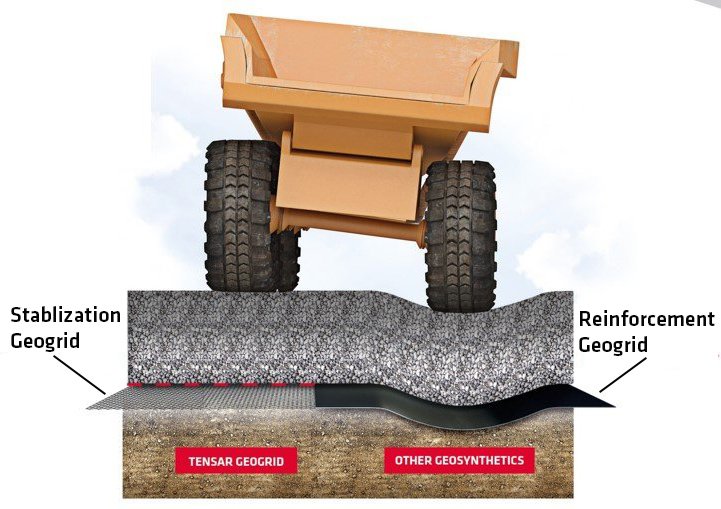
Geogrids have been used in civil engineering for decades, yet one question repeatedly appears from contractors, engineers, and project owners: Does geogrid really work?
The short answer is yes — geogrids are highly effective when correctly selected and properly installed. They improve soil performance, increase bearing capacity, reduce deformation, and extend the service life of pavement and foundation systems.
However, the degree of effectiveness depends on many factors, including subgrade conditions, aggregate quality, installation practices, and the type of geogrid chosen.
This article provides a complete, evidence-based explanation designed to surpass existing online resources and meet modern Google SGE content standards.
1. Geogrid Common Uses?
Geogrids are commonly used for:
-
Road base and subbase reinforcement
-
Unpaved haul roads and temporary access roads
-
Embankments and soft soil foundations
-
Retaining wall and slope stabilization
-
Working platforms for heavy equipment
Their primary function is to reinforce, not replace, the soil. Geogrids modify how soil responds to loads, making the ground stronger and more stable.
2. How Geogrid Works: The Core Engineering Mechanisms

Understanding why geogrid works requires exploring the fundamental engineering mechanisms behind its performance. These mechanisms are widely recognized in geotechnical design and supported by laboratory and field studies.
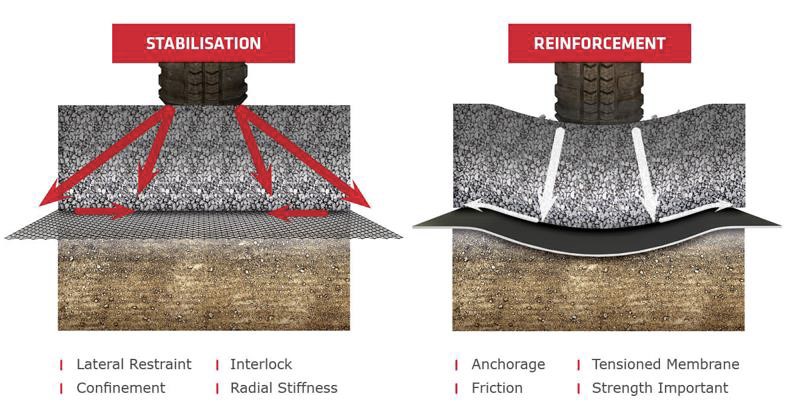
2.1 Lateral Restraint
Soils and aggregates naturally move laterally when subjected to loads. This movement weakens the structure and accelerates deformation.
When placed correctly, a geogrid provides passive resistance to this lateral movement, confining the particles in place.
This increased confinement results in:
-
Higher shear strength
-
Increased stiffness of the reinforced layer
-
Improved resistance to rutting
This is one of the most important mechanisms in unpaved and paved road applications.
2.2 Interlocking Between Particles and Apertures
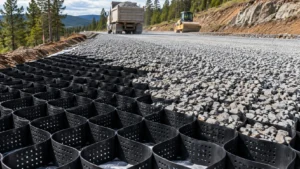
Interlocking occurs when compacted aggregate particles penetrate the geogrid apertures and become mechanically locked with the ribs and nodes.
This mechanism:
-
Creates a reinforced composite material
-
Enhances load transfer
-
Reduces vertical and horizontal deformation
Interlock forms immediately during compaction, which is why many geogrid benefits appear early in construction.
2.3 Improved Load Distribution
Geogrids distribute applied loads over a much wider area. This reduces the stress on the underlying subgrade, especially when the subgrade is soft or prone to settlement.
Benefits include:
-
Reduced vertical strain on weak soils
-
Increased bearing capacity
-
Better long-term structural performance
This mechanism is essential in crane pads, working platforms, and soft-soil embankments.
2.4 Reduction of Rutting and Settlement
Rutting occurs when repeated loading causes permanent deformation.
Geogrids increase the modulus of the aggregate layer, reducing rutting significantly.
Studies show:
-
30–60% rut depth reduction on unpaved roads
-
Longer pavement service life
-
Less frequent maintenance
This also improves safety and durability for high-traffic operations.
Performance varies by application and geogrid type. This biaxial vs uniaxial geogrid selection guide explains why results differ.
3. What Does the Research Say About Geogrid Effectiveness?
3.1 Laboratory Studies
Controlled tests such as:
-
California Bearing Ratio (CBR)
-
Repeated Load Triaxial Testing
-
Plate Load Tests
show significant improvements when geogrids are used.
Typical performance findings include:
-
50% or greater CBR improvement
-
Higher resilient modulus
-
Better cyclic load performance
-
Reduced permanent deformation
These improvements translate directly to real-world performance benefits.
3.2 Field Performance Studies
Long-term monitoring of reinforced roads and working platforms shows:
-
20–40% reduction in aggregate thickness required
-
Dramatically less rutting over time
-
Enhanced performance on soft clays, peat, and organic soils
-
Cost savings due to reduced maintenance demands
Geogrids have enabled successful construction in areas where traditional methods would fail or require excessive material.
4. When Does Geogrid Work Best?
Geogrid performance depends on correct application. It delivers the greatest benefits when:
✔ The subgrade is weak (CBR < 3)
✔ Loads are repetitive or heavy
✔ Cost reduction in aggregate is desired
✔ A long-lasting pavement structure is required
✔ Soft soil reinforcement is needed for embankments
✔ Working platforms must support cranes or heavy machinery
In these scenarios, geogrids often outperform other soil stabilization methods in both performance and cost-effectiveness.
5. When Geogrid May NOT Work Effectively
To provide a balanced, authoritative analysis, it is important to understand where geogrids may underperform — a key factor in Google’s E-E-A-T evaluation.
❌ Poor compaction
Without proper compaction, interlocking does not occur.
❌ Incorrect placement depth
If placed too deep or too shallow, the geogrid will not engage with applied loads.
❌ Inadequate overlap
Overlap is critical to ensure continuity. Insufficient overlap can lead to separation under stress.
❌ Poor soil compatibility
Highly cohesive or extremely fine soils offer limited interlock unless paired with geotextiles.
❌ Using the wrong geogrid
Uniaxial, biaxial, and triaxial geogrids serve different functions. Misuse can drastically reduce performance.
These considerations emphasize that geogrid is effective when used correctly.
6. Geogrid vs. No Geogrid: A Practical Comparison
| Performance Factor | Without Geogrid | With Geogrid |
|---|---|---|
| Rutting Resistance | Low | High (30–60% rut reduction) |
| Load Distribution | Limited | Significantly improved |
| Required Aggregate Thickness | High | Reduced 20–40% |
| Subgrade Stress | High | Lower due to wider load spread |
| Long-Term Maintenance | Frequent | Substantially reduced |
This comparison shows why geogrids are widely used in high-demand engineering environments.
7. Does Geogrid Save Money?
Yes — and often significantly.
Geogrids reduce costs by:
-
Minimizing aggregate thickness
-
Reducing maintenance cycles
-
Enabling construction on marginal soils
-
Increasing service life of roads and platforms
Total project savings of 10–50% are common depending on site conditions.
8. Conclusion: Does Geogrid Really Work?
Yes. Geogrids are an effective, proven, and scientifically supported method of soil reinforcement and stabilization.
They work by confining aggregate, improving load distribution, increasing shear strength, and reducing long-term deformation.
When properly designed and installed, geogrids deliver:
-
Stronger and more stable soil structures
-
Longer-lasting pavements
-
Lower project costs
-
Better performance over weak subgrade conditions
For engineers, contractors, and project owners seeking reliable, cost-effective ground improvement solutions, geogrids remain one of the most efficient technologies available today.
FAQ – Common Questions About Geogrids
Q1. Does geogrid really work?
Yes. When properly selected and installed, geogrids significantly improve soil performance by providing lateral restraint, particle interlock, and better load distribution. This leads to higher bearing capacity, reduced rutting, and longer service life of roads and foundations.
Q2. When should I consider using geogrid?
Geogrids are most beneficial on weak subgrades, under heavy or repetitive loads, for road base and subbase reinforcement, working platforms for cranes and heavy equipment, and soft-soil embankments or retaining structures.
Q3. When might geogrid not work effectively?
Geogrids may underperform if the aggregate is poorly compacted, the grid is placed at the wrong depth, overlaps are insufficient, the soil is incompatible, or the wrong type of geogrid is selected for the application.
Q4. Does geogrid save money on a project?
Yes. By reducing required aggregate thickness, extending pavement life, and lowering maintenance frequency, geogrids can deliver total project cost savings ranging from about 10% to 50% depending on site conditions.
Q5. What types of projects benefit most from geogrids?
Typical high-value applications include unpaved haul roads, temporary access roads, industrial yards, working platforms, port and rail facilities, and infrastructure built over soft or variable soils.