2026 Edition – Fully Updated, Engineering-Grade Content
Geogrids—whether biaxial, uniaxial, polyester (PET), or fiberglass—play a critical role in soil stabilization, retaining wall reinforcement, load distribution, and pavement performance. While modern geogrids are extremely strong and durable, they are also highly sensitive to selection errors, installation mistakes, and misalignment between product type and application.
For contractors, mistakes often result in rework, delays, and performance issues.
For procurement professionals, incorrect specification or product selection can lead to early failure, structural deformation, and unexpected replacement costs.
This guide outlines the most common geogrid mistakes observed across real projects worldwide—and explains how to avoid them with confidence.

🟩 1. Selecting the Wrong Type of Geogrid
This is the most common procurement-related mistake. Each type of geogrid behaves differently under load, moisture, and long-term stress.
Biaxial Geogrid – Common Misuse
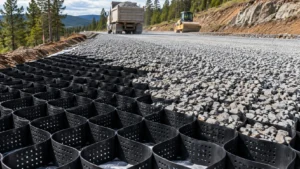
Biaxial geogrids provide equal strength in both directions, making them ideal for base stabilization but unsuitable for primary reinforcement.
Incorrect applications:
-
Retaining walls
-
Structural fill systems
-
Slope reinforcement requiring high tensile load
Correct applications:
-
Road base and subbase stabilization
-
Working platforms
-
Construction access roads
-
Load distribution layers
Uniaxial Geogrid – Common Misuse
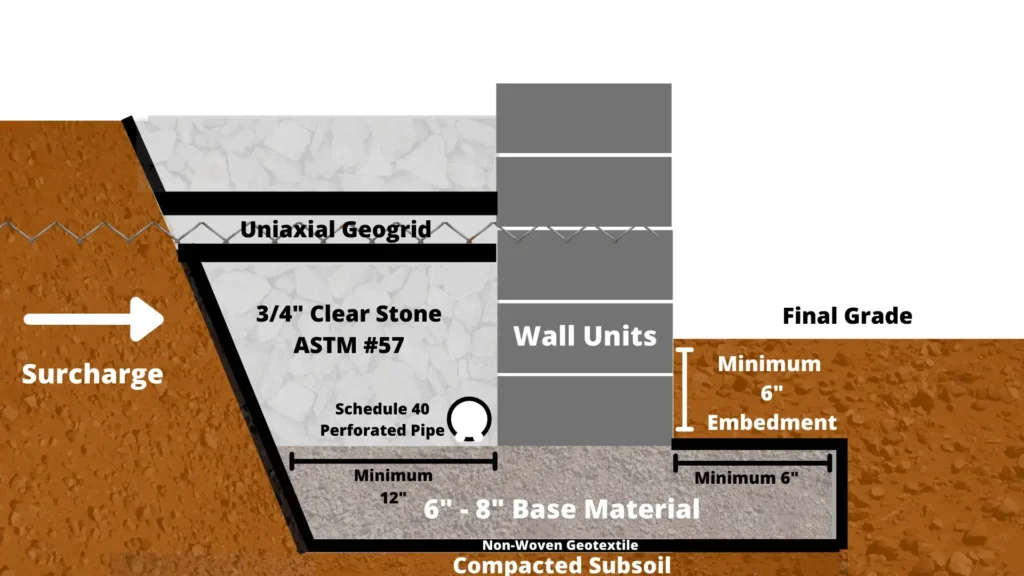
Uniaxial geogrids offer high tensile strength in one direction only, designed to resist long-term loads.
Incorrect applications:
-
Road base stabilization (orientation errors are common)
Correct applications:
-
Retaining walls
-
Reinforced soil structures
-
Steep slopes
-
Embankments and high-fill projects
One of the most common mistakes is choosing the wrong geogrid type. See our biaxial vs uniaxial geogrid comparison guide.
Polyester (PET) Geogrid – Common Misuse
PET grids provide excellent creep resistance but require careful consideration of the exposure environment.
Incorrect applications:
-
Strong alkaline soils
-
Long-term wet environments with high pH
-
High-temperature asphalt layers
Correct applications:
-
High-strength reinforced soil structures
-
High-fill embankments
-
Long-term load applications
Fiberglass Geogrid – Common Misuse
Fiberglass grids are stiff and high modulus but have limited strain capacity.
Incorrect applications:
-
Structural reinforcement requiring flexibility
-
Environments with high alkalinity
-
Constant wet conditions
Correct applications:
-
Asphalt reinforcement
-
Crack control and reflective cracking mitigation
A correct understanding of geogrid types prevents 70% of long-term failures.
Not all geogrids perform the same function. A geogrid selected for aggregate-base stabilization should not automatically be treated as the same product used within an asphalt overlay. Where the required function is asphalt reinforcement and reflective crack control, a coated fiberglass geogrid may be the more relevant product category.
🟩 2. Incorrect Geogrid Orientation
Misorientation is one of the most frequent—and costly—installation mistakes.
Uniaxial Geogrid Orientation
Uniaxial grids must be installed with the strong direction perpendicular to the wall or slope face.
Incorrect orientation can reduce effective strength by up to 70%.
Biaxial Geogrid Orientation
Orientation is less critical, but proper alignment still ensures consistent tensile capacity and even load distribution.
Rule:
Always check MD (machine direction) and TD (transverse direction) before installation.
🟩 3. Insufficient Overlap Between Geogrid Rolls
Overlap governs load transfer and structural continuity between adjacent geogrid panels.
Common mistakes
-
Overlaps less than 10–15 cm
-
Angled or irregular joints
-
Overlaps placed directly in high-load zones
-
No overlap on soft subgrade
Best practice
-
30–45 cm overlap for general soil conditions
-
≥60 cm for soft soils or high loads
-
Use mechanical fastening where specified
-
Overlaps must follow manufacturer alignment guidelines
For optimal performance, pair this with correct layer spacing.
🟩 4. Inadequate Tensioning During Installation
Geogrids must be placed flat, tight, and wrinkle-free.
Slack dramatically reduces interlock efficiency and inhibits load transfer.
Consequences of slack geogrid
-
Reduced shear resistance
-
Uneven settlement
-
Loss of tensile engagement
-
Premature structural deformation
Correct practice
-
Pull the grid taut before anchoring
-
Use stakes, rebar pins, or temporary ballast
-
Check tension after initial fill placement
-
Re-tension areas that shift during compaction
🟩 5. Driving Machinery Directly on Exposed Geogrid
Heavy equipment can damage ribs, crush nodes, and misalign the grid.
Do Not
-
Drive or turn equipment on exposed geogrid
-
Allow rutting from loaders or trucks
-
Drag pallets or construction waste across the surface
Correct practice
-
Cover geogrid with ≥150 mm of suitable fill before vehicle access
-
Use low-ground-pressure equipment for first passes
-
Increase cover to ≥300 mm before heavy compaction
🟩 6. Using the Wrong Backfill or Infill Material
Geogrids rely on interlock, so material selection is extremely important.
Incorrect materials
-
Rounded river gravel
-
High-plasticity clay
-
Organic or lightweight soils
-
Soil contaminated by construction debris
These materials cannot mechanically interlock with the apertures and may cause sliding or shear failure.
Correct materials
-
Angular crushed stone
-
Well-graded granular aggregate
-
Engineered fill meeting project specification
🟩 7. Poor Compaction Practices
Improper compaction remains one of the leading causes of geogrid system underperformance.
Common errors
-
Thick lifts (> 300 mm)
-
Using insufficient compaction energy
-
Compacting with wrong moisture content
-
Skipping compaction near edges
Correct practice
-
Compact each lift to ≥95% Standard Proctor density
-
Use thinner lifts: 200–250 mm maximum
-
Compact uniformly across the entire width
-
Avoid equipment turning during compaction
🟩 8. Poor Drainage and Water Management
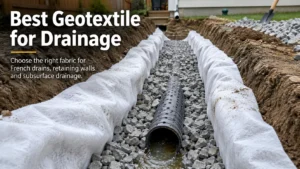
Water is a major factor in geogrid system performance. Poor drainage leads to hydrostatic pressure and long-term deformation.
Common drainage mistakes
-
Using clay as backfill behind walls
-
No granular drainage layer
-
No drainage pipe or weep holes
-
Using fiberglass or PET in highly alkaline wet environments without verification
Best practice
-
Minimum 300 mm drainage layer of crushed stone
-
Perforated drainpipe for retaining walls
-
Proper outlet elevation and discharge path
-
Avoid materials incompatible with site pH
🟩 9. Incorrect Layer Spacing
Proper layer spacing controls the interaction zone between soil and geogrid.
Common mistakes
-
Increasing spacing to save material
-
Deviating from engineered design
-
Mixing different grid types without adjusting spacing
-
Applying biaxial spacing to uniaxial wall designs
Typical spacing values
-
Retaining walls (uniaxial / PET): 400–800 mm
-
Pavement base (biaxial): 200–400 mm
-
High embankments (PET): 600 mm + multi-layer reinforcement
🟩 10. Incomplete Product Verification (Procurement Critical Error)
Many performance issues stem from inadequate verification before ordering.
Common procurement mistakes
-
Relying on MD strength only
-
Ignoring TD strength and junction strength
-
Not confirming polymer type (PP / HDPE / PET / fiberglass)
-
No independent testing report
-
Ignoring creep reduction factors (CRF)
-
Overlooking UV stabilization or coating type
Verification checklist
-
ASTM D6637 (tensile strength)
-
ASTM D7737 (junction strength)
-
ISO 13431 (creep behavior)
-
Melt flow rate or intrinsic viscosity for polymer integrity
-
Coating: PVC, bitumen, or latex depending on application
🔚 Conclusion: Avoiding Mistakes Is the Fastest Way to Improve Project Reliability
Most geogrid failures are avoidable.
With the correct product, verified specifications, and proper installation procedures, geogrids deliver exceptional performance in soil reinforcement applications.
For contractors, avoiding the mistakes above improves efficiency, reduces rework, and extends structure lifespan.
For procurement professionals, correct product selection prevents costly failure and ensures long-term performance.
A geogrid system is only as reliable as the decisions made during selection, installation, and verification.