
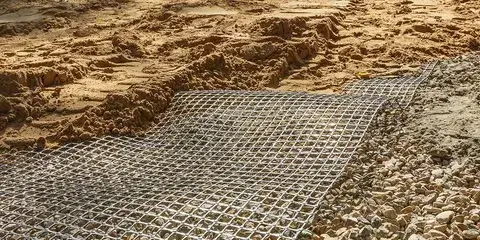
Engineering Decision Guide (2026a Edition)
Short Engineering Answer
Geogrid reinforcement becomes structurally necessary when a retaining wall exceeds the capacity of a gravity system.
Wall height, surcharge loads, soil shear strength, drainage conditions, and foundation bearing capacity determine whether reinforcement is required.
Not all retaining walls need geogrid — but once stability limits are exceeded, reinforcement is no longer optional.
This guide explains the engineering logic behind that decision.

1. The Real Question: What Controls the Need for Geogrid?
The need for geogrid is controlled by five variables:
Wall height
Backfill shear strength
Surcharge loads (driveways, slopes, vehicles)
Foundation bearing capacity
Drainage reliability
If any of these exceed gravity wall limits, reinforcement is typically required.
2. Wall Height Threshold Logic (Practical Reference Table)
| Wall Height | Is Geogrid Required? | Typical Design Approach |
|---|---|---|
| < 3 ft (1 m) | Rare | Gravity wall often sufficient |
| 3–4 ft | Sometimes | Manufacturer dependent |
| 4–6 ft | Often | Reinforcement recommended |
| > 6 ft | Yes | Engineered MSE design required |

If you are specifically evaluating a 4-foot wall, see:
👉 do-you-need-geogrid-for-a-4-ft-retaining-wall
Height alone does not decide — but it is the first screening factor.
3. Internal vs External Stability: Why Reinforcement Is Used

Reinforced retaining walls must satisfy three categories of stability:
Internal Stability
Tensile rupture resistance
Pullout resistance
Connection strength
External Stability
Sliding resistance
Overturning resistance
Bearing capacity
Global Stability
Deep-seated failure of the entire soil mass
Geogrid primarily enhances internal stability by forming a reinforced soil mass behind the wall.
For full installation and construction details, see:
👉 geogrid-retaining-wall-ultimate-guide
4. When Geogrid Is Structurally Required
Reinforcement is typically required when:
Wall height exceeds gravity limits
Backfill soil has low friction angle
Surcharge loads are present
The wall is built near a slope
Foundation soil is weak
Drainage cannot be guaranteed
In these cases, the reinforced zone must extend sufficiently into the retained soil mass.
For embedment and spacing principles, see:
👉 geogrid-retaining-wall-ultimate-guide
5. When Geogrid May NOT Be Required
Geogrid may not be necessary when:
Wall height is under 3 ft
No surcharge load exists
Backfill is high-quality granular soil
Foundation soil is strong
Drainage is excellent
Wall is decorative only
However, this must still align with local codes and manufacturer guidance.
6. The Most Critical Design Variable: Reinforcement Length

The most common failure cause is insufficient embedment length.
Geogrid must extend beyond the active failure wedge.
Short reinforcement = pullout failure risk.
For detailed installation mistakes, see:
👉 geogrid-common-mistakes
7. Uniaxial vs Biaxial: Which Type Is Used for Retaining Walls?
Retaining walls typically use uniaxial geogrid, because tensile demand is primarily perpendicular to the wall face.
Biaxial geogrid is more commonly used in base stabilization.
Detailed comparison:
👉 what-is-the-difference-between-a-biaxial-and-uniaxial-geogrid
8. Drainage: Reinforcement Does Not Replace It

Geogrid does not prevent hydrostatic pressure.
Drainage must include:
Free-draining backfill
Drain pipe
Filter layer
Proper compaction
Without drainage, reinforcement alone cannot prevent failure.
For slope-related applications, see:
👉 geogrid-slope-stabilization
9. Reinforced Soil Wall vs Gravity Wall
| Feature | Gravity Wall | Reinforced Soil Wall |
|---|---|---|
| Height Capacity | Limited | High |
| Material Usage | High concrete | Reduced concrete |
| Cost Efficiency | Lower | Higher |
| Structural Redundancy | Low | Higher |
| Flexibility | Low | High |
Reinforced systems allow taller, more economical structures.
10. Common Engineering Misconceptions
❌ All retaining walls need geogrid
❌ Higher tensile strength is always better
❌ Spacing rules are universal
❌ Drainage is optional
❌ Biaxial works the same as uniaxial
For cost considerations:
👉 what-is-the-cost-of-geogrid-material-in-2025
11. Decision Checklist Before You Build
Ask yourself:
✔ What is the wall height?
✔ Is there a surcharge load?
✔ What is the soil friction angle?
✔ Is drainage fully controlled?
✔ Is foundation soil stable?
✔ Has reinforcement length been calculated?
If the answer to any structural control variable is uncertain, engineering review is recommended.
Conclusion
Geogrid is not automatically required for every retaining wall.
But once structural limits are exceeded, it becomes a design necessity.
The decision depends on wall height, load, soil, drainage, and foundation performance — not guesswork.
Use reinforcement when engineering criteria demand it — not because it is trendy, and not because it is optional.
Use reinforcement when engineering criteria demand it – not because it is trendy, and not because it is optional.


